Before I get started let’s define our nomenclature here. For the purposes of this essay (despite the fact that my four readers are all Americans), I’ll lean European to make things clear. That said:
Football: What we here in America call “soccer”
American football: What Americans call “football”, ie the NFL, college football, Friday Night Lights, and what have you
Soccer: This term will not be used
It is worth noting at this juncture that despite the world’s destain for the US calling football “soccer”, the term actually originates in England from “Association Football”. Look up the etymology your own self. And since England invented football, blame them. Thank you for your attention in this matter.
For basically my entire life (since I was 8 myself and started to play league football), I’ve heard people around the world ask “Why doesn’t America love football like us?”
Americans respond, reasonably: “The games are boring.” The world: “WTF are you talking about? They’re exciting as hell! No one ever stops moving! Constant action! None of those tedious timeouts and play stoppages.” Americans: “The games all end in 1-0 or 1-1 or something. That’s boring.” The world: (in essence) sputter sputter argue argue “Americans are uncultured!” (Or words to that effect.)
And in my opinion, this weekend was the absolutely perfect demo of what the issue is for Americans. Let me ‘splain:
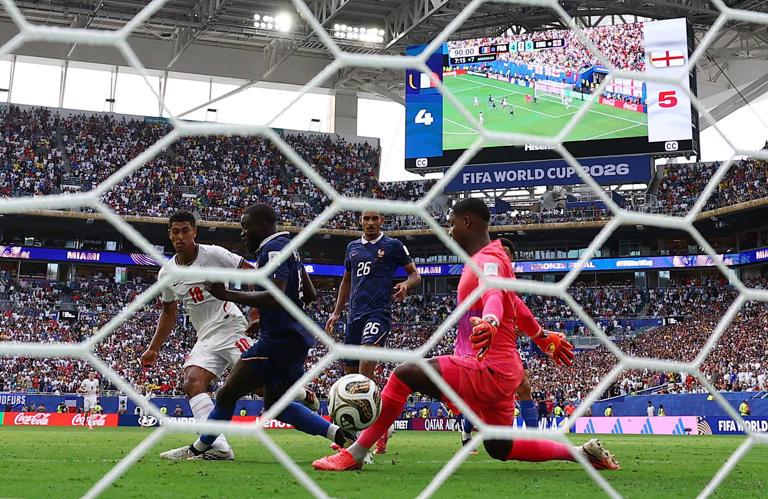
On Saturday evening, I was watching the highlights of the England-France game, which ended in a 6-4 victory for England. And it was fabulous! Massively exciting! Long passes and breaks! Amazing runs! Spectacular ball movement and feints and dribbling! What a game! I’m kinda sorry I missed the game itself.
Here’s the thing: From the commentary—two England Premier League commentators, not Americans—it was clear these guys were thrilled by the game. Beside themselves. Completely enraptured. “This is some great football!” they kept saying. And then one said something that really struck me:
“This is why so many people love this beautiful game.”
The goal in question
This in a game that, at that time, was 5-4. By a couple of professional English football commentators. Not a 0-0 game, or a 1-0 game; a game that ended with ten total goals, which is almost unheard of in World Cup play. That really stuck with me. When the final game between Argentina and Spain ended in 1-0, it made the contrast even more stark for me.
So I did a bit of googling and found that of all the many World Cup games, Google thinks “the all-time number of games with <= 1 [total] goals after 90 minutes is well into the hundreds.” And that made me wonder.
The US has three major sports (as far as the majority of Americans are concerned): American football, basketball, and baseball. Let’s dismiss basketball off the bat; those games end with total scores well over 100. Almost every trip up or down the floor ends with a basket or a block or a foul or something. All the timeouts at the end of close games drives me crazy too, but the games are still fast and high scoring.
There are plenty of low-scoring American football games, yes, but they’re unusual. The typical total number of points in an average NFL game is ~44 points. Given those points are scored in bunches of 6 or 3 it’s not that much, but even if you divide by 7, it’s 6 “goals” total. (I’m trying to compare 1-1 here, as an English football fan recently did on TikTok.)
In football, the average total number of total goals for a Premier League game is 2.93. Less than half of American Football.
This leaves baseball, which I think is a much better comparison. Why is baseball popular in the US but football isn’t? It’s slow. It takes nearly three hours. It has plenty of low-scoring games, too. What’s the problem, you uncultured Americans?!
One thing at a time.
First, the average total number of runs scored in a baseball game is about 8. A 5-3 game is average. These commentators were thrilled by a 6-4 game. Sit with that a bit. But even more important I think are two other things about baseball:
Every at bat has the possibility that you will score with a home run. Even pitchers have been known to clock one now and again. That keeps you ready at any moment. You go get a hot dog during an inning, and you come back and suddenly your team is down 4 runs. (Hence the rush to the food stands between innings.)
Even when your team doesn’t score, there are frequently men on base. Hits. Spectacular plays in the field. Gasp-inducing pitches. Close plays when you get to argue what a bonehead the umpire is. Brush-back pitches. All kinds of things that even a novice watcher can see.
Even more important is the fact that, even though runs are only scored one at a time, one swing of the bat can net you two or three or even four at once. Which when there are more men on base makes each at bat even more exciting. In soccer, a goal is a goal; in baseball, there are run multipliers.
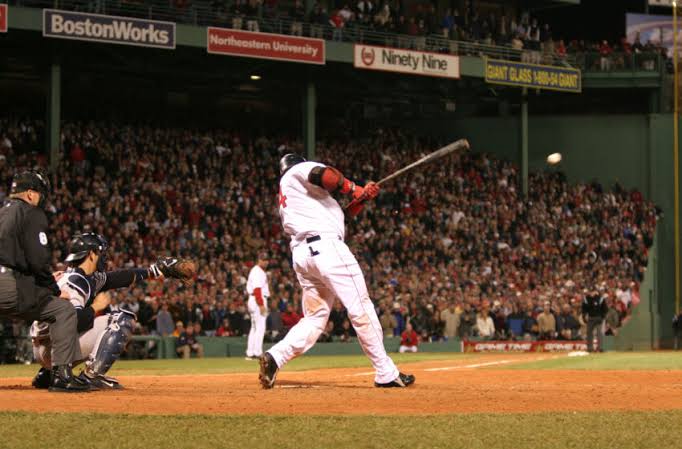
Big Papi producing ecstasy in Red Sox fans everywhere in 2004 (Subtracting adopting my youngest, the birth of my oldest, and my wedding, one of the happiest moments in my life.)
Another argument I’ve heard folks use is, “Well, there are plenty of baseball games that end in a 1-0 game!” There sure are; but they’re the exception. Pitcher’s duals, no-hitters, and perfect games are exciting because they’re rare. In football, they’re the norm.
Now, I want you to understand I’m not suggesting the world change football just to suit the American desire for goals. But I would like the world to consider this, getting back the original motivator behind my post:
Every blog post, TikTok, YouTube video, and social media post I’ve seen found the 6-4 England/France game thrilling. An all-timer. Wonderful. Why they “love this beautiful game”. Think about that a bit and how it might be nice to have that happen a bit more frequently, with the 1-0 games the rarity. The 1-0 games like baseball no-hitters.
I love the Winter Olympics, honestly. Sami and I enjoy watching the figure skating together and regaling each other with our (in my case) half-informed opinions on various skaters, techniques, and move difficulties. I have loved the downhill ever since Franz Klammer’s utterly-insane, gold medal, death-defying final run in Innsbruck in 1976, something that literally took my breath away. I love watching the ski jumping, the men (and now finally women!) flying hundreds of feed down the hill, drifting, drifting, seemingly hanging up there forever. The bobsledders, lugers, and nutty skeleton riders, barreling down the hill inches above the ice at speeds that make me nervous when I’m surrounded by more than a ton of metal and plastic. I really love it.
And I would love to watch it. Except that the network that has a monopoly on all the content–NBC in this case–is completely and utterly against people in my minority group.
No, not Jews. Not nerds either, although there is definitely some overlap there. That group is cable-cutters.
Cable-cutters are folks who gave up on cable or satellite subscriptions, and the networks (especially folks like HBO) absolutely hate us. Or at least that’s the way it appears to us, given their behavior. You see, while most shows are available via Amazon Prime or iTunes or other avenues, “special” content–anything HBO puts out, or Big Events like the Stanley Cup or World Series or, yes, the Olympics–are only available if you sign up on an app, and the only way to sign up on that app is . . . to have a cable or satellite account.
Yup, that’s right gang: If you want to watch “Game of Thrones” or the Olympics on your iPad, you are required to have a cable TV account.
Cable and satellite companies hate and fear families like ours. The way cable companies make money is to force you to buy big packages of content, subsidizing all those channels you never watch by making you pay a premium for the stuff you really want. “A la carte” cable packages are anathema to these people; if you could only pick and choose the 5-10 channels you want, they would lose leverage, money, prime deals with various networks, and I don’t know what else. They don’t want that; they want to continue their monopoly on your content by forcing you to watch what they want to sell you, their way. And people like us are a threat to that model.
And yet just like media companies when the VCR first came out, then DVDs, and then digital content, they’re missing the boat. There are millions of us out there now, consuming our video content from out Macbooks or iPads or Android smartphones, and they are writing us–and millions of potential dollars–off their books entirely. Leaving money on the table. And for a lot of people, forcing them to choose between bad options–buying a cable package you don’t want, waiting months or years to get content that is available for everyone else, or pirating it. And as you might guess, by pulling this nonsense, while blatting on about piracy and how much it’s costing them, the media companies are causing many people to choose that over waiting or signing up for cable accounts. It turns out, unsurprisingly, that when folks are pushed into a corner and forced, they don’t like it and lash out. Not very shocking. (The Oatmeal sums up this dilemma quite well.)
I want to watch the Olympics. I am fine with paying for the content; I don’t even mind watching it the way folks watching broadcast TV have to–with endless commercials, blathering analysis by former athletes, and a flood of “up close and personal” clips. But no, that’s not an option. I can either get a cable account (for two weeks of content), go to the local bar or whatever, or pirate it. And for any of those choices, my dollars are left on the table and NBC doesn’t get them.
We are nearly 20 years into the web era, media companies, and a good half-dozen deep into the streaming era. Companies like Netflix are producing shows for people to binge-watch. And you are still trying to force folks to sign up for cable or satellite contracts? Pull yourselves into the future and figure it out, or you’re going to be left behind.