• About
  • Follow
  • Life: An Odd Analogy
  • Making Debates Suck a Wee Bit Less
  • To heck with the good ol’ days
  • Writing

Random Blather

~ Feverish ravings of a middle-aged mind

Random Blather

Tag Archives: Android

Sometimes computer stuff just breaks

15 Monday Jan 2024

Posted by dougom in Uncategorized

≈ 1 Comment

Tags

Android, Apple, computers, technology, Windows


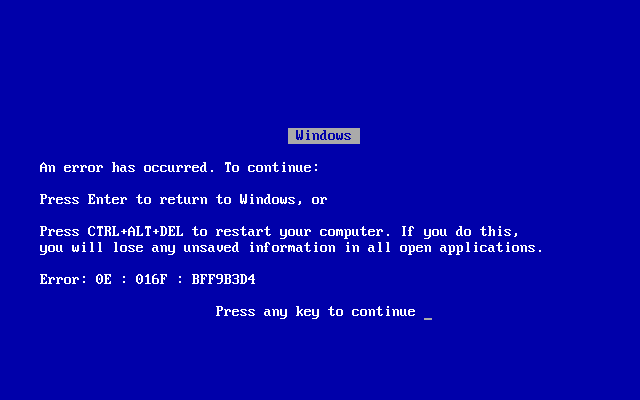
The infamous Windows Blue Screen of Death

My first job out of college in the high tech industry was doing front-line phone support for a startup software company. The software ran on a Windows box, which back in those days were pretty rudimentary. I mean, a 100MB hard drive was considered “lots of space”. It was a long time ago.

I got in big trouble with my boss’ boss, the CEO of the company (and the guy whose arrogance, incidentally, drove the company into the ground rather than sell it to a big Japanese firm and make us all a bunch of money rather than the company folding), after one frustrating phone call with a customer. This was well before phone support people had “scripts”; we had a written list of common problems people faced, and after that we were required to solve their issues as best we could. And I was fresh out of school.

After spending a good half-hour trying to fix this guy’s problem, I finally had him reboot the system and the problem cleared up. When he demanded I tell him what might have gone wrong, I told him that sometimes, hardware just has the equivalent of brain farts, and you have to reboot to clear them. He wasn’t happy with this answer and called the CEO.

Here’s the thing, though: I’ve learned since then that computer software and hardware does sometimes just fail for no discernible reason. Sometimes it has a brain fart, and you have to reboot it.

It’s a fact of life. And why? Because the entire edifice of hardware and software is a precariously-balanced inverted pyramid that is only kept working by the tireless attention of millions of people. Let me explain:


There’s a reason folks didn’t build ’em this way

Down at the bottom, there? The point on which all computer systems rest is a little switch that either turns on or off. I know you’ve almost certainly heard it before, but it’s important to remember: No matter how sophisticated a computer system is, down at the bottom, it’s just a bunch of switches turning on and off. That’s all. When you turn on your tablet and the screen lights up, it’s just tens of millions of switches inside turning on and off telling the electronics what to do. All web sites are, at bottom, controlled by millions of switches flipping on and off. Yes, it sounds insane, but it works.

Back in the day, it was actual physical switches (eg vacuum tubes) that people literally switched on and off by hand in order to “program”. What’s happened over time is that the switches have gotten microscopic, and the systems that turn them on and off more sophisticated. But to repeat myself: The point of that inverted pyramid is just switches going on and off.

The next layer of the pyramid is “machine language”, which is a stream of ones (on) and zeros (off) sent directly to the switches. On top of that is a whole host of languages converting pseudo-english into those ones and zeros. On top of that is a host of languages that talk to those languages. And on top of that are the programs you run every day on your laptop, phone, car, or whatever. We are adding to those pyramid layers all the time, and at this point the pyramid is huge, and world-wide. And still balanced on a point.

Sometimes, a switch fails, or a program has an error and sends the wrong signal to a switch and it gets turned on when it should be off. Or a user (that’s you, kids!) sends a command into this giant edifice that the programmers haven’t anticipated, and it causes an unusual situation. When that happens, one of the blocks of the pyramid gets knocked out, and the thing goes off balance. And when the whole thing is balanced on a point, it can go off balance pretty badly, and your phone or laptop or whatever hangs.

Now, computer scientists have shored this delicate system up by surrounding the pyramid with lots of other pyramids so they can lean on each other and not be quite so precarious. And then pyramids get stacked on top of those pyramids, reinforcing the structure (and incidentally making a bad failure more catastrophic, but never mind that for now). We have devoted countless hours to creating backup systems that back up other backup systems that are behind even more backup systems. We don’t want your devices to fail. Especially if that “device” is, say, an airplane. And this all works pretty well in the main.

But every once in a while something unexpected happens in the system, and your device just hangs, or gives you the famed “blue screen of death”, or “bricks” (ie stops working entirely). The vast majority of these problems can be relieved by rebooting the device, although sometimes even that doesn’t work and you’re hosed.

Today my son brought me his iPhone because it had done hung. The weather in Austin is below freezing, we’re getting a lot of phone alerts, and somehow an alert had popped up on his phone at just the right microsecond—or maybe he happened to be holding down a button when it popped up—so that the message couldn’t be dismissed because the screen also wouldn’t accept input. Further, his phone couldn’t be rebooted in the ordinary way, with the ol’ hold-down-a-volume-button-and-the-power-button trick. So I had to go online and google for whatever backup plan C is to reboot iPhones. And it worked, because we have a bunch of backups now, despite this insane inverted pyramid structure.

(And if I may add another analogy: Computers are a lot like the sailing ships of yore in that they accumulate the data equivalent of barnacles on their hull. And just like a sailing ship had to be careened and scraped on a regular basis, this is why you need to reboot your phone or laptop every once in a while. To get those electronic barnacles off.)

So the bottom line is: Sometimes the system brain farts and needs to be reset. That might have PO’d that long-ago customer, but it’s simply the nature of the beast.

The PITA Principle

14 Wednesday May 2014

Posted by dougom in Opinion

≈ Leave a comment

Tags

Android, Apple, business, economics, high tech, iTunes, marketing, sociology

pain-in-the-ass-300x300
Image courtesy of Wiggins Marketing

OK, yes: I should be flogged for such a bad pun.  I beg forgiveness.

I’m in high tech, and in high tech we love our acronyms.  We love them so much, we even have an acronym for them:  TLAs, or “three-letter acronyms”.  Sometimes you get longer ones, but often they’re three letters.  But in this case we have a four-letter acronym: PITA.  “Pain in the ass”.  And I want to share a theory with y’all about why certain things get adopted by the public and world at large, and other things don’t.  I call this The PITA Principle.

The PITA Principle is simple:  The more of a pain in the ass something is to do, the less likely people will do it.  This seems obvious, right?  But the thing is, when you look at a lot of things that seem confusing from a rational perspective–why don’t people buy electric cars more often?–it’s because of The PITA Principle.  Having an electric car is more of a PITA than a gasoline car.  The world infrastructure is designed around gas cars that can be refueled in a few minutes, every 300 miles or so.  Gas stations are distributed accordingly.  People plan their trips based on this.  Their subconscious expectations are all geared towards it.  So why would you switch from something that goes 350 miles on a single refueling, said refueling taking less than 5 minutes, to something that goes less than 100 miles on a single charge, and recharging takes hours?  Even if doing so is cheaper, and more environmentally sound?  The PITA Principle, baby; it’s easier.  I think it’s that simple.

This explains the adoption of a ton of things that might–especially to curmudgeons–seem weird.  Why email rather than physical mail?  It’s easier!  The PITA Principle!  You can email in seconds, from your laptop, wherever you are; to mail something physical requires stamps and envelopes and licking and walking to the mailbox and paying money.  It’s not much of a PITA, but it’s more of one than sending email.

Which also explains why teens text so durn much; it’s even less of a PITA than email.  And furthermore, it’s less of a PITA (for a teen) than talking on the very same phone!  “Why?” you might reasonably ask.  Because when you talk on the phone, you have to be in a location with a reasonable amount of privacy, as does your calling partner; you have to deal with the emotional content of their voice, and correspondingly control your own vocal dynamics; you have to hang up or put the person on hold if interrupted, and so do they; and on and on.  It’s more of a PITA.  Texting is easier.  Teens text.

Or move on over into the political realm.  Despite the fact that the Republicans’ platform is out of step with more than 2/3 of the country (seriously; look it up), they continue to be competitive, are in charge of the House of Representatives, numerous states, may grab the Senate, and continue to be competitive in Presidential elections.  How is that possible?  Democrats far outnumber Republicans; Democratic positions (raise the minimum wage; increase Medicare and Medicaid coverage; improve Social Security; get government out of doctor/patient decisions; etc.) are wildly popular compared to Republican positions.  How do they keep winning?  Yes, incumbency; yes, Gerrymandering; yes, cheating.  But I also believe the PITA Principle plays a big role.  What’s easier?  Voting for the guy (or woman) who you’re familiar with, whose name you know, who you are used to.  “The Devil you know.”  The PITA point is lower.  Incumbents win because voting for them is easier.  The PITA Principle.

This is reflected in a lot of high tech success stories.  Not all, but some.  Why did Apple sell a b’zillion iPods, when there were so many other MP3 players out there?  Because by browbeating record companies and artists and publishers and making iTunes pricing very consistent, and making the downloading process easier and simpler than the competitors, Jobs lowered the PITA factor to a point where it was significantly better than his competitors, and thus won the market.  Why do people still buy more iPhones than Android phones?  Lower PITA point.  (Though Android is now very, very close, and in some ways better.)  Why do iPads continue to outsell other tablets?  The PITA point, which not only takes in the tablets themselves, but how they interact with iTunes, your computer (particularly if you’re using a Mac desktop or laptop), and the other iPads, iPhones, and Macs in your home.  Apple’s products, in the main, have extremely low PITA points, and they charge accordingly.

You can also see this, very much, in a business environment.  For example, at a previous job at [formerly awesome company that no longer exists], one team was performing software source control using a very sophisticated, graphical interface tool, while another team used a very rough-and-ready, command-line tool for their source control.  The graphical tool was more powerful, more technically sophisticated, did a better job and ensuring source security, was superior at preventing source collisions and workflow errors . . . and people hated it, and we all eventually moved back to the command-line tool, kludgy though it was.  Why?  The graphical tool was way more of a PITA to use and maintain, and the command-line tool was simpler and easier to use (and easier to spoof when something went wrong, too).  The lower PITA point won out, even though the company was actually selling the graphical tool!  A lower PITA point buys you a lot.

I’m sure someone smarter than me, with better math, economic, sociological, and business knowledge, would be able to put together charts, graphs, figures, and PowerPoint slides to make this into a true scientific study.  I’m sure there’s some kind of way to enumerate PITA values for particular products or processes, and correlate PITA points to prices and profit margins, but I’m not that guy.  John Nash could probably do it and win another Nobel Prize.  But I’m just a humble writer.  A humble writer who sincerely hopes someone smarter does take up this gauntlet, and see where it goes.

Subscribe

  • Entries (RSS)
  • Comments (RSS)

Archives

  • July 2024
  • February 2024
  • January 2024
  • August 2023
  • April 2023
  • February 2023
  • January 2023
  • October 2022
  • April 2022
  • February 2022
  • January 2022
  • December 2021
  • November 2021
  • September 2021
  • April 2021
  • January 2021
  • July 2020
  • May 2020
  • April 2020
  • March 2020
  • October 2019
  • November 2018
  • October 2018
  • May 2018
  • April 2017
  • September 2016
  • April 2016
  • March 2016
  • December 2015
  • November 2015
  • July 2015
  • May 2015
  • April 2015
  • March 2015
  • February 2015
  • January 2015
  • December 2014
  • November 2014
  • October 2014
  • September 2014
  • August 2014
  • June 2014
  • May 2014
  • April 2014
  • March 2014
  • February 2014
  • December 2013
  • November 2013
  • October 2013
  • September 2013
  • August 2013
  • July 2013
  • June 2013
  • May 2013
  • June 2008
  • April 2008
  • March 2008
  • February 2008
  • January 2008
  • December 2007
  • November 2007
  • October 2007
  • September 2007
  • August 2007
  • July 2007
  • June 2007

Categories

  • Fiction
  • Grammys
  • Joni Mitchell
  • Music
  • News
  • Opinion
  • personal
  • Uncategorized

Meta

  • Create account
  • Log in

Blog at WordPress.com.

  • Subscribe Subscribed
    • Random Blather
    • Join 85 other subscribers
    • Already have a WordPress.com account? Log in now.
    • Random Blather
    • Subscribe Subscribed
    • Sign up
    • Log in
    • Report this content
    • View site in Reader
    • Manage subscriptions
    • Collapse this bar
 

Loading Comments...