
Tags
adhd, ASD, austism, Autism, autism spectrum disorder, mental health, neurodivergent, neurodiversity
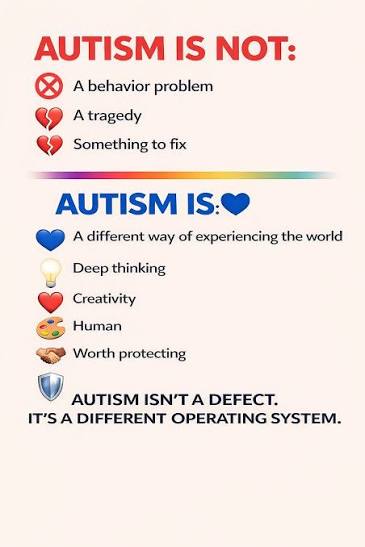
I know it’s hip to make fun of people who convert denigrating and insulting descriptive terms like “retard” and “mongoloid” and even “handicapped” to “autistic” (or on the spectrum), Down’s syndrome, and disabled. Right-wingers especially like to call folks who do so “politically correct” or “woke” or whatever. But the fact is, as my dad once said after castigating himself for using an insulting descriptive of my brother that made him cry, words can hurt. Words have meaning, they have power, and all my life (pretty much) I’ve worked hard to use the right words.
Since my then-son (now trans daughter) was diagnosed with autism when she was 15, I have worked to come up to speed on not just autism, but AuDHD (which is her complete diagnosis, along with other things), and neurodivergence in general. And the more I study it, and fold it into my knowledge of history, and my knowledge of myself, the more pissed off I am that the condition is described as “autism spectrum disorder”.
Side note: I will herein use the terms “on the spectrum” and “autistic” interchangeably. I am doing this purposefully. After talking to many neurodivergent folks, it is clear that some prefer one, and some the other. My daughter for example prefers “autistic” and says, “I have autism”. So I’m going with that.
Which is why I have moved to “neurodivergent” (ND) and “neurotypical” (NT) when I am describing non-standard mental processing. When you are dyslexic, for example, is your brain processing things wrong, or just differently? I posit it’s the latter, and that our language should reflect that. I find it difficult to believe that these types of brains could have survived for tens of thousands of years if they weren’t useful in some way.
Which is a long introduction to my saying: I think the DSM V description of autism is utter bullshit. There are a couple reason I think this, and I’m going to give the historic one first: In my opinion, the vast majority of human advances have been made by neurodivergent folks.
Think about it. Einstein had multiple copies of the exact same suit in his closet so he “didn’t have to think about” what he was wearing each day. Need for routine is a common sign of autism. How much time did Marie Curie spend working on radioactive elements? Watson and Crick studying DNA? Does anyone seriously think Isaac Newton—who risked his eyesight coming up with theories of light—was neurotypical? And some of you have seen A Beautiful Mind, right? John Nash was schizophrenic, and won the friggin’ Nobel Prize. Thomas Edison tried thousands of different materials to find the right filament for a light bulb. And the guy punched the time clock every day even though he owned the place! Tell me that’s not a sign of neurodivergence.
So calling autism a “disorder” really pisses me off. Neurodivergent folks (including myself!) process incoming data from the world differently than neurotypical folks, but is it a “disorder”? Please.
Now there’s no question that many neurodivergent folks struggle for various reasons. If you have a friend or family member who is bipolar, you’ve seen it for yourself. Or if you’ve lived with someone with significant ADHD and wondered why TF they leave all their clothes on the floor and the dishes piled in the sink. Or you’ve seen someone with Tourette’s. It can be a burden, and in some cases a huge burden. (My youngest daughter struggles all the time.) I’d never deny that.
And yet there are millions and millions of people who not only live with their neurodivergence, but often make it work for them. When a neurodivergent person hyperfocuses, they can discover a new vaccine, or write thousands of lines of software code, or pull a Sherlock Holmes (a clear case of neurodivergence if ever there was one) and solve a mystery. Or whatever.
Which brings me back to the DSM V description of “Autism Spectrum Disorder”. I am a tech writer. Converting the turgid prose and confusingly-expressed ideas of people who are experts in software or hardware is my jam. So let me share this with you from their description:
A. Persistent deficits in social communication and social interaction across multiple contexts, as manifested by the following, currently or by history (examples are illustrative, not exhaustive, see text):
- Deficits in social-emotional reciprocity, ranging, for example, from abnormal social approach and failure of normal back-and-forth conversation; to reduced sharing of interests, emotions, or affect; to failure to initiate or respond to social interactions.
- Deficits in nonverbal communicative behaviors used for social interaction, ranging, for example, from poorly integrated verbal and nonverbal communication; to abnormalities in eye contact and body language or deficits in understanding and use of gestures; to a total lack of facial expressions and nonverbal communication.
- Deficits in developing, maintaining, and understanding relationships, ranging, for example, from difficulties adjusting behavior to suit various social contexts; to difficulties in sharing imaginative play or in making friends; to absence of interest in peers.
Specify current severity: Severity is based on social communication impairments and restricted repetitive patterns of behavior.
Now let me revise this a bit:
A. Persistent differences from neurotypical standards in social communication and interaction across multiple contexts, as shown by the following, currently or by history:
- Differences from neurotypicals in social-emotion reciprocity that can include any or all of the following areas: Unusual social approach and significant differences from standard back-and-forth conversation; atypical sharing of of interests, emotions; atypical affect; extreme reluctance to initiate or respond to social interactions; requiring preparation for and recovery time from social gatherings.
- Differences from neurotypicals in nonverbal communicative behaviors used for social interaction that can include any or all of the following areas: Verbal communication and visual and bodily affect; eye contact, body language, and understanding and use of gestures; lack of or major differences in facial expressions for given situations.
- Differences from neurotypicals in developing, maintaining, and understanding relationships in any or all of the following areas: Difficulty adjusting behavior to suit various social contexts; difficulties in sharing imaginative play or making friends; absence of interest in peers.
Specify amount of current differences from neurotypicals: Amount is based on social communication differences and restricted repetitive patterns of behavior
The change here is simple: From judgement terms like “”deficits”, “abnormal”, “poorly integrated”, to nonjudgmental ones like “differences”.
Am I denying that these neurological differences make it difficult for folks on the spectrum to engage in social situations? Of course I’m not! What I am saying is that a) these are differences, not “disorders”, and b) these folks almost always bring something else to the table that a neurotypical person might not. Might not even be able to!
I could translate the entire diagnostic criteria, but I’m sure I’ve hammered this point home and the horse is dead as a doornail at this point, but: Neurodivergent folks are different, not better, not worse. Neurodivergent folks are dealing with different brain wiring and processing, not suffering from a “disorder”.
How do I know? Because I’m one of those neurodivergent folks, and somehow I’ve managed to have a long career, make lifelong friends who care about me, maintain family connections, play team sports, have hobbies like Lindy Hop dancing and playing D&D, and no one has ever thought I suffered some kind of “disorder”. Whether it’s OCD (I have to come up with a better term for that one) or autism, or whatever it is, it’s obvious to anyone who’s known me in person for any period of time that I’m different, but not “disordered”.
So if you have a friend or relative or loved one who is neurodivergent, remember: They are different, not broken. They can almost certainly see things in a way you don’t that will surprise you. And they most certainly don’t deserve to be denigrated with negative terminology.
Thank you for attending my TED talk.


Approximately 117 billion humans have ever lived on Earth since the dawn of our species. It strains even the most basic credulity to imagine that anything resembling a “norm” has ever been established. No one knows, for example, whether the “blue” they see is exactly the same “blue” as anyone else.
Absurdity is doing your own thing and believing everyone else is wrong.